What is GPT-6 Astra?
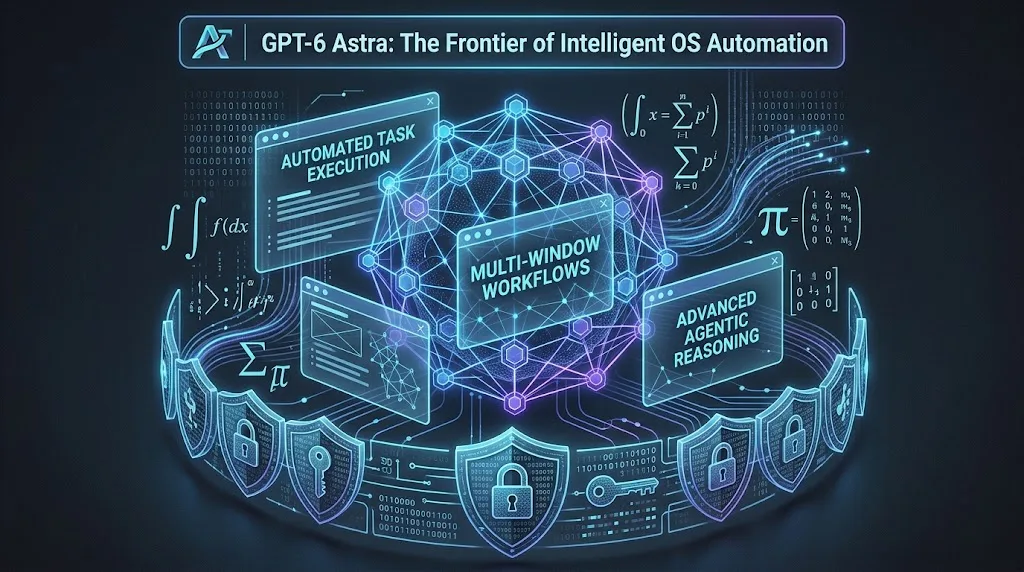
OpenAI’s GPT-6 Astra is positioned as the “world’s most intelligent and aligned” frontier flagship model, succeeding GPT-5.6 Sol. It focuses on reasoning, computer use, and agentic work. The model advances three core directions: state-of-the-art computer-use capability, a qualitative leap in professional work output, and crossing the “Critical” cybersecurity threshold under OpenAI’s Preparedness Framework.
The most practically valuable numbers come from OSWorld 2.0: Astra scores 72.6% with an average task time of about 40 minutes, compared with GPT-5.6 Sol’s 65.7% in about 75 minutes — roughly a 47% reduction in wall-clock time. The combination of higher accuracy and lower latency determines whether an agent needs constant human supervision or can be trusted to complete tasks. The model is available via the OpenAI API (model name gpt-6-astra) and Amazon Bedrock, with a GPT-6 Astra Pro tier for Pro, Business, and Enterprise plans. Full official details are available on OpenAI’s announcement page.
Core New Capabilities
Astra’s upgrades center on agentic execution.
End-to-End Computer Control

It can directly operate a computer to complete multi-step tedious work such as bulk-filling expense forms, updating CRM records, running frontend QA checks, and installing/debugging software with visual screen access. OSWorld 2.0 measures whether a model can navigate real interfaces, click, type, and finish tasks the way a human would. The 47% reduction in per-task time is as important as the accuracy gain because agent cost scales linearly with wall-clock time.
Note that independent tests by the ARC Prize show that the “headline” computer-use and reasoning numbers are highly harness-dependent. On ARC-AGI-3, a standard stateless harness scores roughly 17%–63%, while the advertised ~99.9% requires a stateful provider-adapter harness whose full runs can cost tens of thousands of dollars. Stateless API calls should be expected to score noticeably lower than the published charts.
Deliverable Professional Artifacts & Focused Questioning
Astra is trained to produce professional documents, decks, spreadsheets, and analyses that match the user’s templates, extracting only relevant context while preserving tone and layout. Via ChatGPT Sites it can create, host, and share websites, web apps, and games directly from a prompt. It decides when to ask a focused question versus when to make a reasonable assumption and continue; it fills routine gaps itself and pauses only on critical decisions. When requirements change mid-task it can incorporate the new constraints without losing the original goal.
Codex Cross-Window Notes & Defensive Cybersecurity
In Codex, Astra introduces retrievable notes that persist across context-window boundaries, replacing repeated summary compression. Even when a note does not cover a detail, the model can still recover earlier requirements or test results from prior messages. On cybersecurity, Astra has reached the “Critical” threshold under OpenAI’s Preparedness Framework. At launch it supports secure code review and patching but refuses to generate proof-of-concept exploits. OpenAI plans to gradually relax restrictions through the Daybreak program (vulnerability validation, malware analysis, detection engineering). Additional safety checks may pause legitimate defensive work, so users should budget for interruptions.
Benchmark Performance
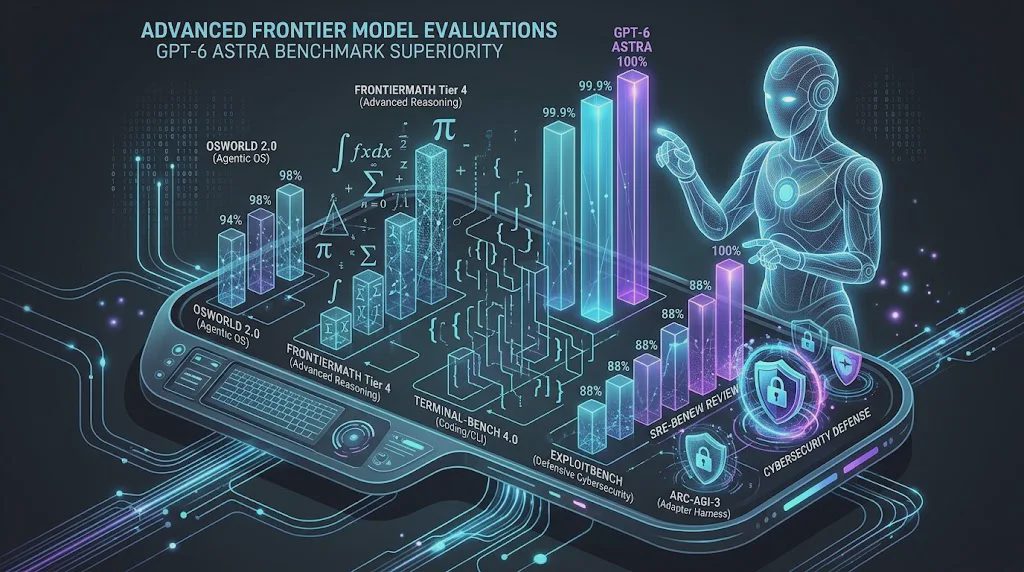
Astra sets new highs on computer use, mathematics, coding, and cybersecurity, often while using fewer output tokens. Scores are OpenAI-reported and should be interpreted with harness caveats in mind.
• OSWorld 2.0: 72.6% (Sol 65.7%, Claude Opus 5 70.2%); ScreenSpot-Pro 92.7% (Sol 76.9%); Agents’ Last Exam 59.3%.
• Math & Science: FrontierMath Tier 4 v2 97.6% (Fable 5.1 and Fable 5 both 87.8%); GPQA Diamond 96.0%. However, on the tool-augmented Humanity’s Last Exam it scores only 57.2%, trailing Claude Fable 5.1’s 65.0%.
• Coding: Terminal-Bench 4.0 57.7% (Sol 37.3%, Fable 5.1 55.8%); FrontierCode 1.1 Main ≈53.3%, essentially tied with the Claude series.
• Cybersecurity: ExploitBench 100% (Sol 78.5%, Opus 5 70%); SRE-Bench one-shot solve rate 88.0%.
• ARC-AGI-3 & Long Context: 99.9% under the provider-adapter harness; MRCR v2 8-needle 100% at 256K–512K and 96.3% at 512K–1M.
• Alignment: Internal computer-use safety benchmark 2.4% (lower is better; Sol 22.0%); overall misalignment rate in realistic work settings 3.4% (Sol 18.8%).
Selected comparison table:
Benchmark | GPT-6 Astra | GPT-5.6 Sol | Claude Fable 5.1 | Claude Opus 5 |
OSWorld 2.0 | 72.6% | 65.7% | - | 70.2% |
FrontierMath Tier 4 | 97.6% | 83.0% | 87.8% | 73.2% |
Terminal-Bench 4.0 | 57.7% | 37.3% | 55.8% | 52.3% |
ExploitBench | 100% | 78.5% | - | 70% |
ARC-AGI-3 (adapter) | 99.9% | 7.8% | - | 30.2% |
Further independent analysis can be found in OSWorld discussions and OpenAI’s official system card.
Pricing, Availability & Usage Guidance
GPT-6 Astra first rolled out to a limited set of organizations and is now expanding to all ChatGPT Plus, Pro, Business, and Enterprise users, as well as via the OpenAI API and AWS Bedrock. Enterprise admins can enable it per workspace (default off at launch).
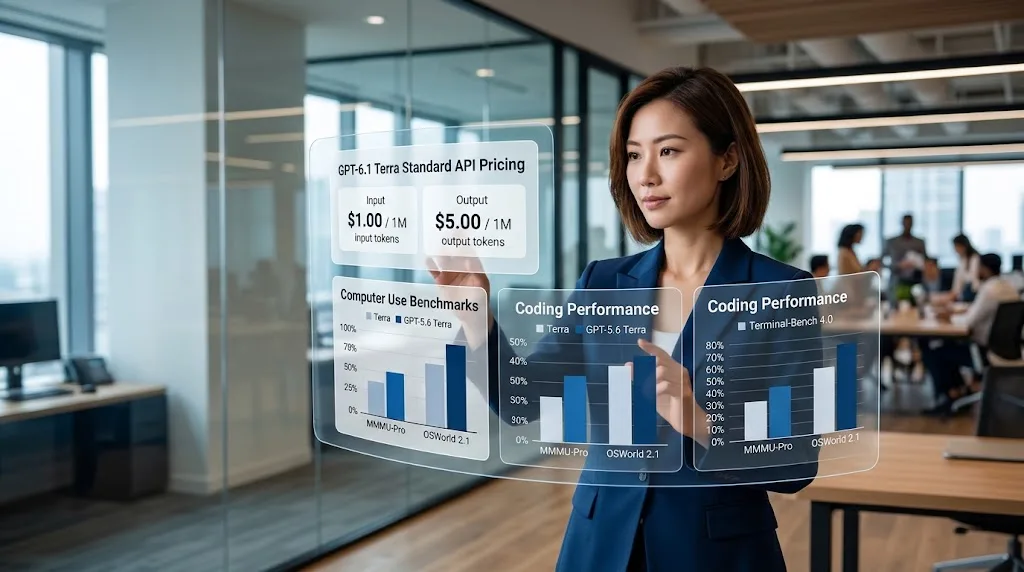
Standard API pricing is $10 per million input tokens and $50 per million output tokens. Fast mode offers up to 2.5× speed at 2× the standard price; cache reads/writes are billed separately. This is substantially higher than GPT-5.6 Terra ($2/$12) and Claude Opus 5 ($5/$25), reflecting its positioning as a frontier reasoning and automation model rather than a high-volume text workhorse. Zero Data Retention is supported for eligible API customers; subscription plans include usage credits with the option to purchase additional capacity.
Best-fit use cases include agentic computer use, professional document/slide generation, long-horizon coding sessions in Codex, and defensive cybersecurity work (code review and patching). The strong retrieval reliability at the 1M-token scale suits document-intensive workflows. The $10/$50 price point is not ideal for routine bulk text tasks that cheaper models can handle.