GPT-6.1 Terra is OpenAI’s fast, efficient model for visual reasoning, computer use, and clear writing. OpenAI presents it as an upgrade over GPT-5.6 Terra for everyday communication and computer-based tasks, including drafting proposals, interpreting technical drawings, filling out forms, and editing videos.
The main questions for prospective users are straightforward: how much does it cost, what improvements has OpenAI reported, and which workloads are a good fit? This guide focuses on those questions using OpenAI’s published information.
What is GPT-6.1 Terra?
GPT-6.1 Terra is designed to combine visual understanding with actions in computer environments. OpenAI highlights use cases such as matching product photos to catalog entries, interpreting technical drawings, acting on application screens, and drafting or revising text.
The API model ID is gpt-6.1-terra. The model supports text and image input, with text output. Its documented context window is 1,050,000 tokens, and its maximum output is 128,000 tokens. Tool calling requires the Responses API.
Official model documentation: GPT-6.1 Terra API model page
GPT-6.1 Terra pricing
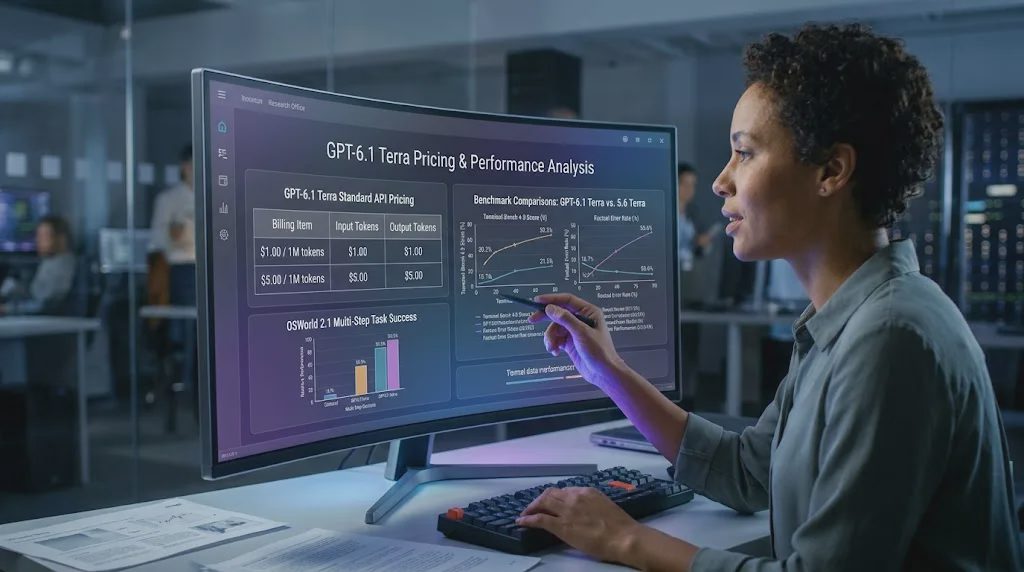
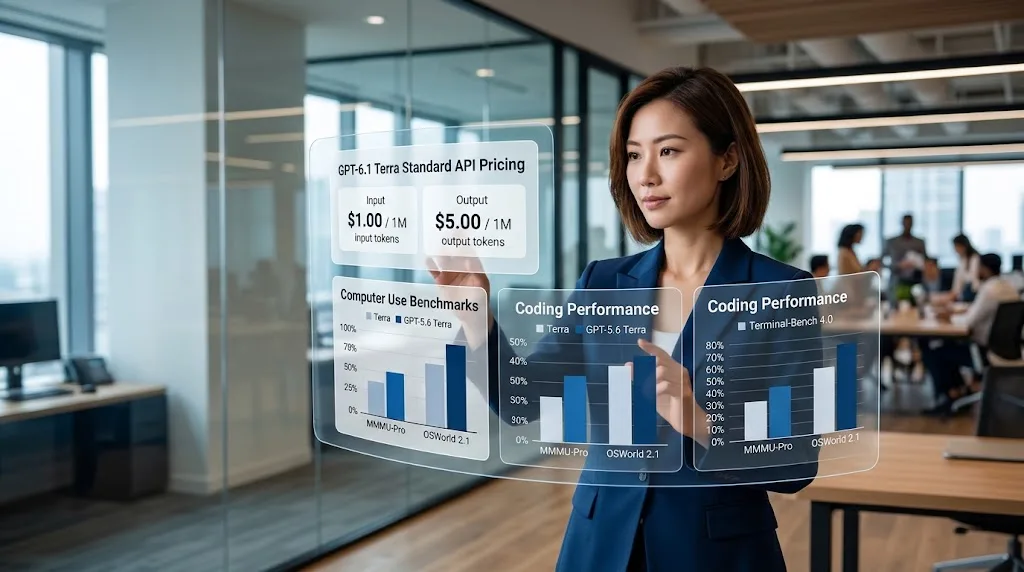
OpenAI lists standard API pricing at $1 per million input tokens, $5 per million output tokens, and $0.05 per million cached input tokens. OpenAI says the model’s standard API prices are 50% lower than those of GPT-5.6 Terra and GPT-6.1 Sol.
Billing item | GPT-6.1 Terra standard price |
Input tokens | $1.00 / 1M tokens |
Cached input tokens | $0.05 / 1M tokens |
Output tokens | $5.00 / 1M tokens |
Cache writes — 30-minute retention | $1.25 / 1M tokens |
Cache writes — 12-hour retention | $2.50 / 1M tokens |
A few pricing details matter when estimating production costs. Requests with more than 272K input tokens are priced at twice the input and cache rates and 1.5 times the output rate for the full request. Batch and Flex prices are 50% below standard pricing. Fast mode costs twice the standard rate, and regional processing carries a 10% premium where available. Check the live pricing documentation before budgeting a deployment.
Official pricing: OpenAI API pricing documentation
What OpenAI reports about computer use
OpenAI evaluated GPT-6.1 Terra on Agents’ Last Exam, a benchmark of professional tasks. The company reports that at medium reasoning effort, Terra scored 15 percentage points higher than GPT-5.6 Terra while costing about one-third as much per task. OpenAI also reports that, at maximum effort, Terra completed these tasks more than three times faster than GPT-6 Astra and GPT-6.1 Sol.
OpenAI also reports that GPT-6.1 Terra outperforms GPT-5.6 Terra at every reasoning setting on MMMU-Pro, a visual-reasoning benchmark. On OSWorld 2.1, which evaluates agents using desktop applications to complete multi-step tasks, Terra at medium reasoning effort surpassed GPT-5.6 Terra’s best score at a fraction of the cost per task.
These are results reported by OpenAI under the company’s stated benchmark conditions. They are useful indicators, but they do not guarantee the same success rate on every application or workflow.
Coding performance: Terminal-Bench 4.0
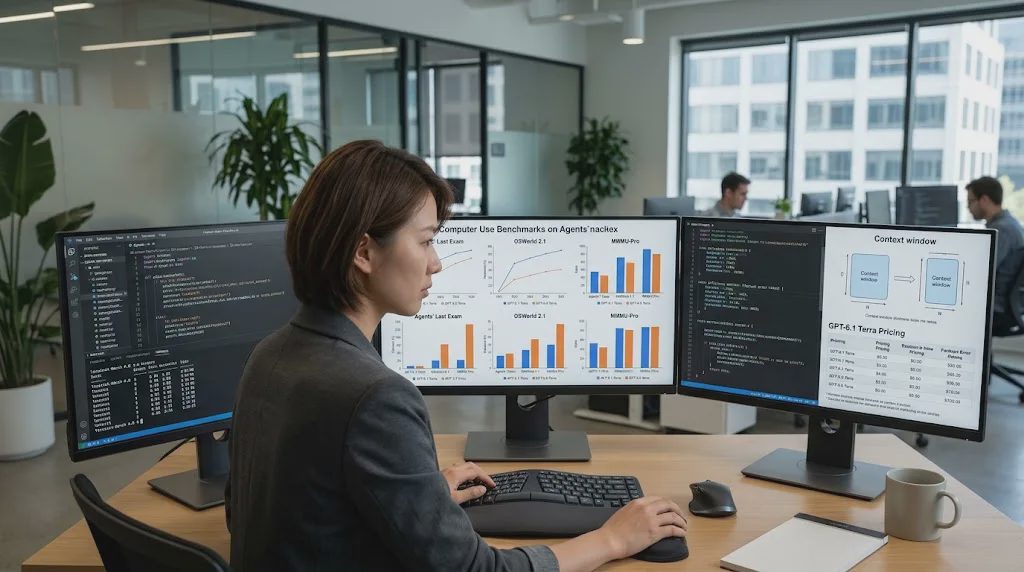
Terminal-Bench 4.0 evaluates how well coding agents solve problems from the command line. OpenAI reports that GPT-6.1 Terra solved 50.3% of tasks at maximum reasoning effort, compared with GPT-5.6 Terra’s published score of 21.5%.
This is a substantial improvement on that benchmark, but it should not be interpreted as proof that Terra is the best model for every software engineering task. OpenAI specifically notes that GPT-6.1 Sol and GPT-6 Astra remain better choices for its most complex coding tasks.
OpenAI also reports results on Terminal-Bench-Science 0.1, a benchmark for agents using code in scientific research tasks. At maximum reasoning effort, the company says Terra surpassed GPT-6.1 Sol at lower cost and came within five points of Claude Opus 5.5 while costing less than one-fifth as much by its estimate.
Official benchmark details: Introducing GPT-6.1 Terra
Factual accuracy and error rates
OpenAI reports results from its internal benchmark of prompts designed to induce factual errors. At low reasoning effort, the error rate fell from 53.6% with GPT-5.6 Terra to 16.7% with GPT-6.1 Terra, a decrease of nearly 37 percentage points. At maximum reasoning effort, the error rate fell by 18 percentage points to 4.3%.
These figures describe OpenAI’s internal evaluation, not a universal hallucination rate. Performance can vary with the topic, prompt, available evidence, and task. For work involving money, customers, compliance, or public claims, verify important facts against primary sources and keep a human review step.
Safety and task boundaries
OpenAI says GPT-6.1 Terra retains protections developed for GPT-6 Astra and meets the Critical threshold in cybersecurity under its Preparedness Framework. The company also reports improvements in staying within the task scope, disclosing limitations and blockers, and resisting prompt-injection attempts in its tests.
These statements describe OpenAI’s own evaluations and safeguards. They do not mean the model is immune to mistakes or malicious inputs. For computer-use workflows, start with low-risk actions, restrict permissions where possible, and require confirmation before consequential changes.
Availability and supported capabilities
OpenAI says GPT-6.1 Terra is available to Plus, Pro, Enterprise, and Edu users in ChatGPT Work and Codex. Developers can also access it through the OpenAI API using the model ID gpt-6.1-terra.
The API documentation lists support for streaming, function calling, structured outputs, web search, file search, image generation, code interpreter, hosted shell, apply patch, computer use, MCP, and tool search. Supported tools and endpoint behavior may differ by API and implementation, so check the model documentation before building a workflow.
When should you consider GPT-6.1 Terra?
Based on the use cases and results OpenAI describes, Terra is worth evaluating for workflows such as:
· High-volume tasks where API cost matters.
· Reading and transferring information from documents or invoices into business software.
· Interpreting images or technical drawings.
· Routine command-line coding tasks with clear success criteria.
· Multi-step desktop workflows that can be checked before completion.
For complex engineering work, OpenAI recommends considering GPT-6.1 Sol or GPT-6 Astra. The most reliable way to choose is to test candidate models on a small set of representative tasks and compare total cost, successful completion, correction time, and elapsed time.
A practical way to evaluate the model
Select 10–20 real tasks from your workflow. Run the same tasks with your current model and GPT-6.1 Terra, keeping the inputs and success criteria consistent. Track total cost, first-pass success, human correction time, and completion time. This gives you a more useful decision than relying on benchmark scores alone.
For a related practical approach to evaluating ChatGPT in everyday work, see Thirty Days of Practical ChatGPT Use: What Stayed, What Failed, What I Dropped.
The bottom line
OpenAI positions GPT-6.1 Terra as a cost-efficient model for visual reasoning, computer use, writing, and selected coding tasks. Its published results show improvements over GPT-5.6 Terra on OpenAI’s computer-use, visual-reasoning, factual-error, and Terminal-Bench evaluations, alongside lower standard API prices.
The practical takeaway is to consider Terra for repeatable, high-volume work and test it against your own tasks. For the most complex coding problems, OpenAI says GPT-6.1 Sol and GPT-6 Astra remain better options. Your final choice should depend on verified results from your own workflow.