Have you ever asked ChatGPT to create a career plan, suggest a side hustle, or help you start a business, only to receive an answer that sounds reasonable but feels surprisingly generic?
The problem may not be ChatGPT’s ability to help. It may be the way you ask.
When you give ChatGPT a broad request with little personal context, it has to fill in the missing details itself. It doesn't know your experience, goals, budget, available time, or limitations. As a result, it often produces advice based on general assumptions rather than your actual situation.
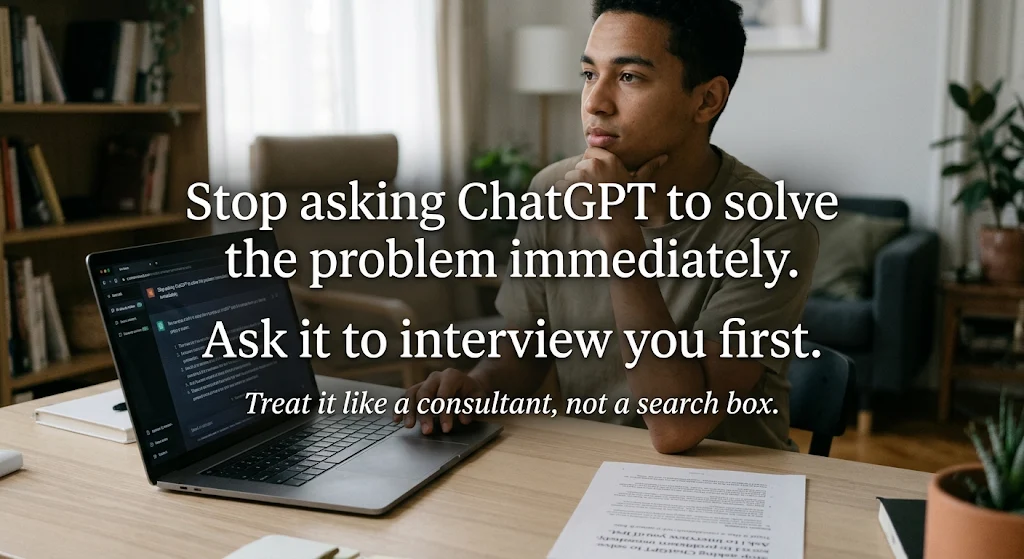
There is a simple way to get better results: Stop asking ChatGPT to solve the problem immediately. Ask it to interview you first.
Instead of treating ChatGPT like a search box, treat it like a professional consultant who needs to understand your situation before making recommendations.

Why Asking ChatGPT Directly Often Produces Generic Answers
Consider a simple example.
You open ChatGPT and type:
"Help me create a career development plan."
ChatGPT might respond with familiar suggestions: identify your strengths, improve your skills, build your professional network, update your resume, and set long-term goals.
Nothing is necessarily wrong with this advice. However, it could apply to almost anyone.
ChatGPT doesn't know whether you're a recent college graduate, an experienced professional considering a career change, or someone returning to work after several years. It doesn't know your salary expectations, preferred working environment, financial responsibilities, or willingness to relocate.
The same problem appears in other situations:
"Recommend a profitable side hustle." ChatGPT doesn't know how much time or money you can invest.
"Write my resume." It doesn't know your actual achievements, responsibilities, or professional strengths.
"Create a learning plan." It doesn't know your current skill level, learning objectives, or daily availability.
"Write a business plan." It doesn't know your target customers, resources, competition, or risk tolerance.
The result is often a polished answer that lacks personal relevance.
The solution isn't necessarily a longer prompt. It's a better conversation.
The Trick: Tell ChatGPT to Interview You Before Answering
Rather than asking for an immediate solution, give ChatGPT a different role: an experienced professional who must understand your circumstances before making recommendations.
For example, instead of typing "Help me plan my career," try this:
Copy-and-paste prompt:
"You are an experienced career development consultant. Don't give me a career plan immediately. First, interview me to understand my professional background, skills, interests, work experience, income goals, and long-term career expectations.
Ask me one question at a time. Wait for my response before asking the next question. If my answer is unclear or incomplete, ask follow-up questions to get more specific information.
Once you have collected enough information, summarize what you've learned, identify my strengths and potential challenges, and create a practical career development plan based on my actual circumstances.
Avoid generic advice. Make recommendations that are realistic for my situation."
The difference is significant.
Instead of guessing what kind of career advice you need, ChatGPT starts gathering the information required to make useful recommendations.
It becomes an interactive consultation rather than a one-way question-and-answer exchange.
5 Practical Ways to Use the Interview-First Method
This approach works particularly well when a task involves personal circumstances, multiple decisions, or information that ChatGPT cannot reasonably know without asking.
Here are five practical examples.
1. Career Planning: Find a Direction That Fits Your Background
A generic career plan might recommend learning new skills, networking, and applying for better opportunities. An interview-based approach can go much further.
Try this prompt:
"Act as an experienced career strategist. Before recommending a career direction, interview me about my education, previous jobs, technical skills, interests, salary expectations, preferred work environment, and long-term goals.
Ask one question at a time. Explore my transferable skills and identify any gaps between my current qualifications and the roles I want.
After the interview, suggest three realistic career paths, explain the advantages and disadvantages of each, and create a step-by-step development plan."
This is especially useful for recent graduates, professionals considering a career change, and people who feel stuck in their current jobs.
2. Side Hustles: Find Opportunities That Match Your Resources
Searching for "the best side hustles" usually produces familiar ideas such as freelancing, affiliate marketing, dropshipping, and selling digital products.
But a profitable opportunity for one person may be completely unsuitable for another.
Someone with five free hours per week and $200 to invest has very different options from someone who can dedicate 20 hours per week and has $5,000 available.
Try this prompt:
"Act as a practical small-business and side-hustle advisor. Before suggesting any income opportunities, interview me about my available time, existing skills, financial resources, interests, income goals, and risk tolerance.
Ask one question at a time. Don't recommend opportunities until you understand my situation.
Then suggest three side hustles that match my resources. For each option, explain the startup costs, time commitment, potential challenges, required skills, and realistic path to generating revenue.
Avoid unrealistic income promises or business ideas that depend on assumptions about my resources."
The key is that ChatGPT considers your actual constraints instead of simply listing popular ways to make money online.
3. Resume Writing: Discover Your Achievements Before Writing
One of the biggest mistakes people make when using AI to write resumes is asking it to generate a resume before providing enough information.
A resume should reflect real experience, measurable contributions, and relevant skills. ChatGPT cannot accurately highlight these things if it doesn't know what you've accomplished.
Try this prompt:
"Act as a professional U.S. resume writer and career coach. Before writing my resume, interview me about my previous positions, daily responsibilities, major projects, measurable achievements, technical skills, and professional strengths.
Ask one question at a time. Help me identify accomplishments that I may have overlooked.
After gathering enough information, summarize my strongest qualifications and help me turn my actual experience into clear, achievement-focused resume bullet points.
Do not invent job responsibilities, metrics, certifications, or accomplishments."
This approach can help uncover valuable experience that might otherwise be missing from your resume.
4. Learning Plans: Build a Schedule Around Your Actual Ability
Asking ChatGPT to create a 30-day learning plan is easy. Following that plan is another matter.
A learning schedule that assumes two hours of daily study won't work for someone who only has 30 minutes available.
Before creating a learning plan, ChatGPT should understand your starting point and what you want to achieve.
Try this prompt:
"Act as an experienced learning coach. Before creating a study plan, interview me about my current knowledge, learning goals, available study time, preferred learning methods, and any difficulties I've experienced.
Ask one question at a time. Assess my current skill level before recommending learning materials or exercises.
Once you understand my situation, create a realistic 30-day learning plan with weekly milestones, daily tasks, practical exercises, and ways to measure progress."
You can use this for learning English, programming, digital marketing, data analysis, or almost any skill that requires consistent practice.
5. Business Planning: Let ChatGPT Challenge Your Idea First
A business plan generated from a single sentence can look impressive, but it may overlook important risks.
For example, if you ask ChatGPT to write a business plan for an online pet products store, it might immediately produce sections about market opportunities, target customers, marketing channels, and revenue projections.
But does it know your budget? Your suppliers? Your competitors? Your intended sales channels?
Before writing the plan, make ChatGPT examine the idea.
Try this prompt:
"Act as a critical business consultant and potential investor. Before helping me develop a business plan, interview me about my business idea, target customers, product positioning, startup budget, competitors, sales channels, and available resources.
Ask one question at a time. Challenge my assumptions and identify potential weaknesses in the business model.
Once you have enough information, summarize the opportunity, identify the biggest risks, and help me develop a realistic business plan.
Don't simply agree with my idea. Point out problems and explain what needs further validation."
This is particularly useful because the goal isn't just to generate a business plan. It's to determine whether the idea makes sense in the first place.
The Four-Step Workflow for Better ChatGPT Conversations
Once you understand the interview-first approach, you can apply it to almost any complicated task.
The process is straightforward:
Step 1: Let AI ask questions.
Tell ChatGPT not to produce an immediate answer. Ask it to interview you and collect the information relevant to your situation.
Step 2: Provide detailed answers.
Answer honestly and include specific details whenever possible. If ChatGPT asks about your budget, give it a realistic range. If it asks about your experience, describe actual projects and responsibilities.
Step 3: Ask AI to analyze what it has learned.
Before requesting the final output, ask ChatGPT to summarize your situation, identify missing information, and explain the main factors influencing its recommendations.
Step 4: Refine the result.
Review the initial recommendations and provide feedback. You can ask ChatGPT to compare alternatives, adjust assumptions, explore risks, or revise the plan based on new information.
This process turns a single prompt into a more useful, structured conversation.
One More Instruction That Makes This Method Work Better
There is one additional instruction worth including in almost every interview-based prompt:
"Do not ask all your questions at once. Ask only one question per message, wait for my answer, and use my previous responses to determine what to ask next."
You can also add:
"If you already have enough information to make a reliable recommendation, stop interviewing me. Don't ask unnecessary questions just to extend the conversation."
This prevents ChatGPT from overwhelming you with a long questionnaire or asking questions that don't contribute to the final result.
For particularly complex tasks, you can also request a final summary of the information it collected and correct any misunderstandings before allowing it to proceed.

Stop Treating ChatGPT Like a Search Box
The real advantage of ChatGPT isn't simply that it can generate answers quickly. It's that it can participate in an ongoing conversation, ask follow-up questions, recognize missing information, and adjust its recommendations as it learns more about your situation.
When you ask a broad question, you often get a broad answer. When you let ChatGPT understand your circumstances first, you give it a much better foundation for solving the actual problem.
You don't need to write increasingly complicated prompts every time you use AI.
Sometimes, the most effective instruction is simply:
"Don't answer me yet. Interview me first. Ask one question at a time until you understand what I actually need."
Try it the next time you face a complicated decision. You may find that the quality of the conversation changes long before ChatGPT gives you its final answer.