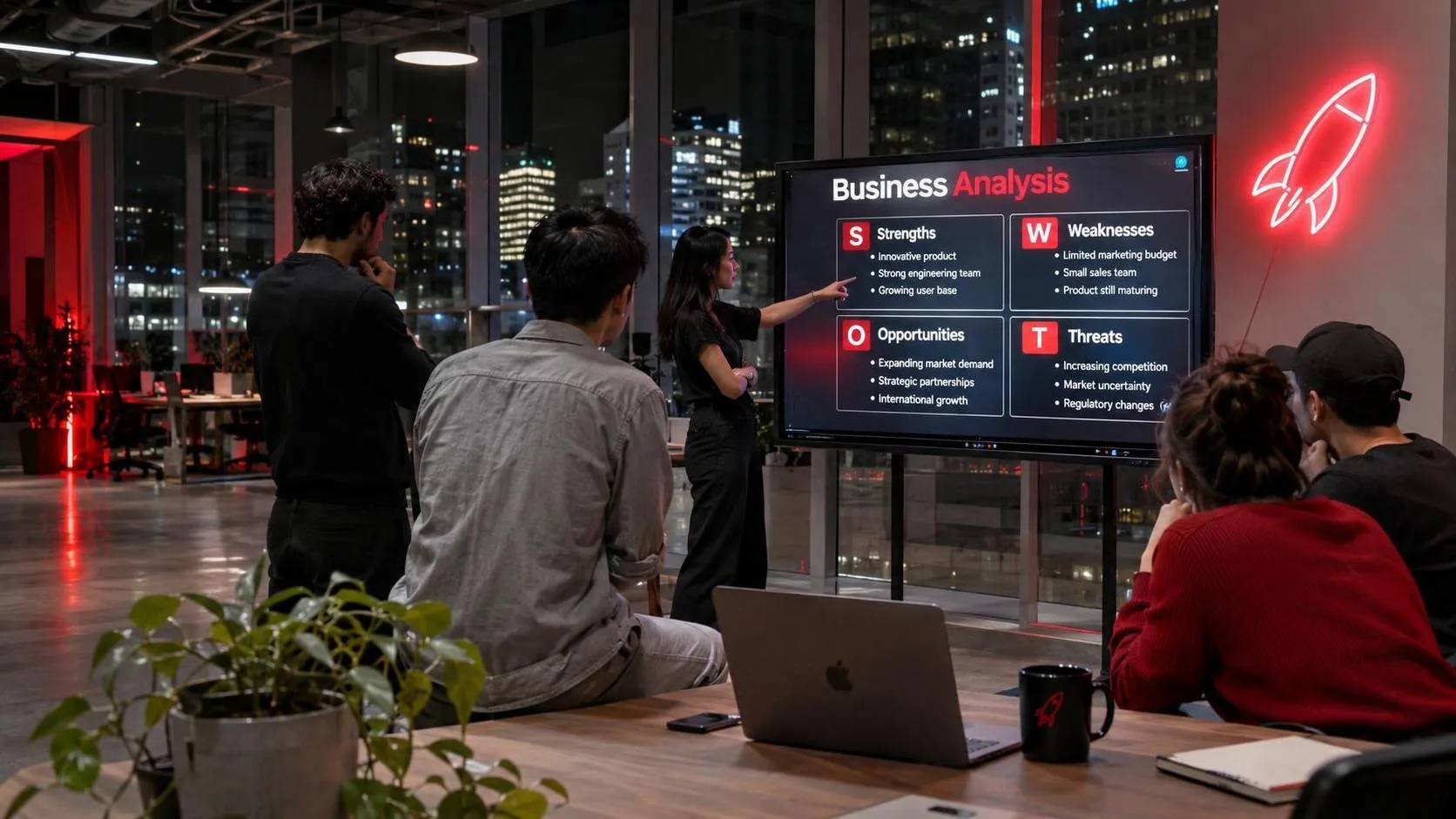
A swot chart template gives you four places to put the facts and questions surrounding a decision: strengths, weaknesses, opportunities, and threats. Start with the copyable version below, fill it out using what you actually know, and pick one action to take. ChatGPT can help sort messy notes, but it cannot tell you whether an assumption about your workplace or customers is true.
A simple chart you can copy
A SWOT chart is usually drawn as a two-by-two grid. If a grid is fussy in your document, four headings work just as well. Copy the following text into a document and replace the bracketed prompts with your own notes.
Decision or goal: [Describe the specific decision you are evaluating.]
Strengths: [What internal resources, skills, or advantages can you rely on?]
Weaknesses: [What internal gaps or limitations could make the goal harder?]
Opportunities: [What outside conditions could help you?]
Threats: [What outside conditions could get in your way?]
Next action: [Choose one useful step, an owner, and a date to review it.]
The distinction that trips people up is internal versus external. Strengths and weaknesses describe things within the team, project, or organization you are evaluating. Opportunities and threats describe conditions outside it. A small team with limited coverage is a weakness; a new competitor is a threat.
You do not need a dozen entries in each box. Two or three specific points are enough to start a useful conversation. “Communication” is vague. “Only one person knows how to update the schedule” gives the team something it can actually address.

A filled-in example for a workplace decision
Suppose a small office is considering whether to introduce a shared request form for routine supply orders. This is a fictional example, not a claim about a particular workplace. Its swot chart template might look like this:
Decision or goal: Introduce one shared form for routine supply requests.
Strengths: The team already uses a shared workspace. One coordinator can review requests each morning.
Weaknesses: Some employees currently order by email. The coordinator needs backup coverage when absent.
Opportunities: The existing workspace may support a form and a shared request list. A standard intake process could make recurring needs easier to spot.
Threats: A vendor may change delivery schedules. An existing purchasing policy could restrict how orders are submitted.
Next action: Ask the purchasing lead to confirm the policy, then have the coordinator draft a sample form for review by the end of the week.
Notice the difference between a fact and a possibility. The form might help reveal recurring needs, but that outcome is not guaranteed. Likewise, the purchasing policy is something to check, not an obstacle the example assumes is real. Labeling uncertainty keeps a tidy chart from turning into a confident-looking guess.
Use ChatGPT to sort notes, not invent facts
If your notes are scattered across a meeting agenda and a scratch pad, ChatGPT can help organize a swot chart template. First, check whether your employer permits that use and which account or tool is approved. Remove names, customer details, financial figures, internal project names, and other sensitive information before entering anything. If the remaining details are still confidential, use a fictional example or organize the notes yourself.
Here is a prompt you can adapt. Replace the sample notes with information you are allowed to share:
“Organize these notes into a SWOT chart for the decision to introduce a shared supply-request form. Use four headings: strengths, weaknesses, opportunities, and threats. Treat strengths and weaknesses as internal, and opportunities and threats as external. Do not invent facts. Put anything unclear under ‘Questions to verify.’ Suggest one small next step.
Notes: The team uses a shared workspace. Requests currently arrive by email. One coordinator reviews orders, but needs backup. We need to check the purchasing policy.”

A reasonable response would place the shared workspace under strengths and the lack of backup under weaknesses. It should put the policy question under “Questions to verify,” rather than claiming the policy permits or prohibits the form. It may suggest drafting a form after the policy check.
Read every line before sharing the result. If the tool turns “we need to check the policy” into “the policy blocks new forms,” correct it or remove it. Also watch for plausible but unsupported additions, such as claimed cost savings or employee enthusiasm. Those are easy to miss because they sound like useful business language.
Turn the chart into a decision
A completed swot chart template is a snapshot, not a plan. Look across the four sections and ask which combination matters most. In the supply-request example, the shared workspace is a strength, but the lack of backup is a weakness. A sensible next step might be to identify a second reviewer before asking the whole office to use the form.
Then separate actions from questions. “Draft a sample form” is an action. “Does purchasing policy allow it?” is a question for someone who knows the policy. Give each item an owner and a review date so it does not become another document sitting quietly in a folder.
You can also ask ChatGPT to suggest connections between entries, such as using an existing resource to address a weakness. Treat those suggestions as options for discussion, not instructions. A recommendation may overlook staffing limits, accessibility needs, approval requirements, or facts you deliberately left out for privacy.
When to update or skip the chart
Use the swot chart template before a planning meeting, when comparing a proposed change, or when a team needs a shared view of a messy decision. Revisit it when an important condition changes or after the review date you chose. Mark new information clearly rather than pretending the original chart predicted it.
For a straightforward decision with an obvious next step, a full analysis may be unnecessary. And for a high-stakes legal, financial, safety, or personnel issue, the chart is only an organizing aid; consult the appropriate qualified person before acting.
The practical goal is not four perfectly balanced boxes. It is a clearer decision, a short list of things to verify, and a next step someone can actually take. Useful beats impressive.